Estimia Marketplace: AI Takes the Request, the System Finds the Installer
A homeowner who wants new windows rarely knows profile systems or glazing formulas, and an installer can’t quote on “I need three windows”. Estimia’s marketplace lets the client describe the job in their own words, turns it into a request installers can price, and sends it to companies that can actually take it.
The Challenge
A lead in the window trade usually arrives as a phone number and a sentence. The installer calls back, asks the same ten questions, drives out to measure, and only then finds out whether the job is worth it. The homeowner, meanwhile, has given their phone number to several companies and is getting calls from all of them.
Estimia set out to fix both sides at once: a request that already contains what an installer needs to give a price, sent only to companies that serve the area and have room for the work, with the client’s contact details kept private until they choose someone. This case covers the marketplace behind the Estimia site - the public calculator and regional pages have a case study of their own.
Describe the Job, the AI Asks the Rest
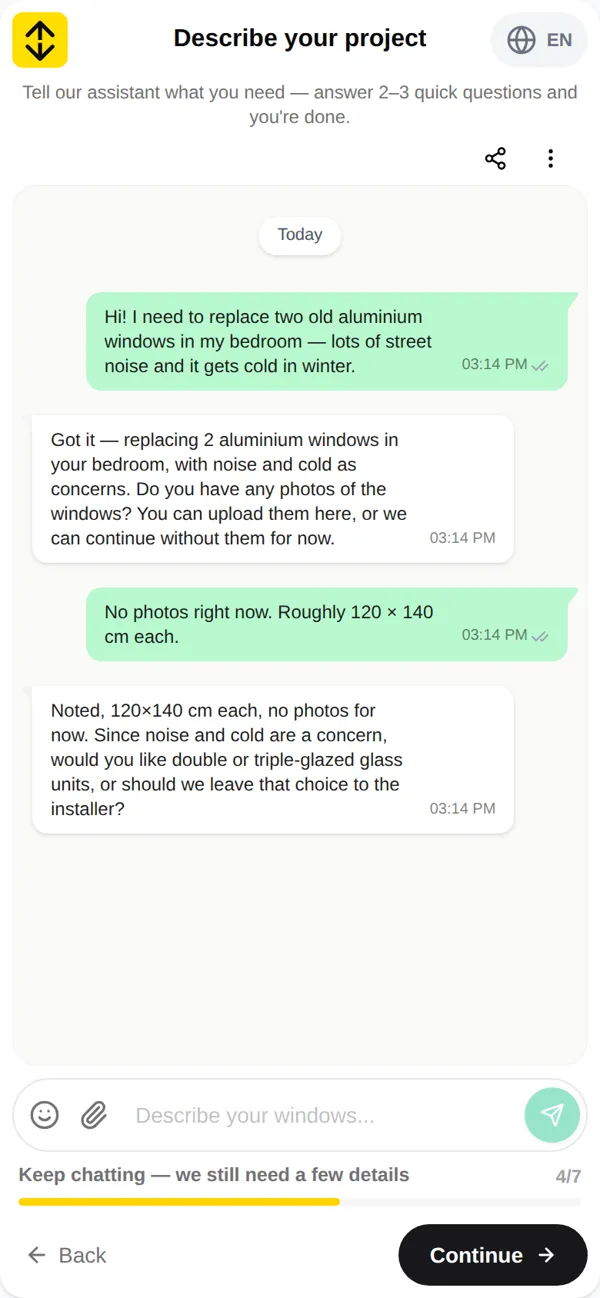
The fastest way in is “Just describe it”. The visitor writes what they need - “two old aluminium windows in the bedroom, street noise is a problem” - and can attach photos or PDFs of a plan or an old quote. An AI assistant then asks follow-up questions, one at a time and in a fixed order of importance: the type of project, how many openings, photos, rough sizes, single, double or triple glazing, frame colours inside and outside, roller shutters and mosquito nets, and finally noise and sun. If the client doesn’t know the sizes, the assistant tells them the company will measure on site. It never quotes a price and replies in the visitor’s own language.
While the conversation runs, a second, silent step rebuilds a structured brief after every message: project type, number of openings, size notes, whether a site survey is needed, what the photos show, glazing, colours, shutters, noise and sun priorities, urgency and a one-paragraph summary for the installer. A progress dial shows the visitor how complete the request is. At the end the assistant recaps the points as a list and the visitor presses Continue.
The conversation can be shared: one button saves a copy of the chat under a private link, so a spouse or a landlord can read it and continue. Only the text is shared; photos stay with the original request.
The assistant runs on Anthropic Claude, with limits on message length, conversation length and requests per visitor, and every conversation is logged for the admin team with its summary and token usage.
Or Build the Window Yourself
Visitors who know what they want choose “Configure exactly” and get the full Estimia window configurator inside the same wizard: material, profile, opening type, glazing and exact sizes, with the price updating as they build. Several windows and other products can go into one basket, and the wizard keeps what was configured while the visitor moves back and forth between steps.
Both paths end in the same short checkout:
- Extras - photos, measurements and comments, all optional.
- Location - just a postcode. No name and no phone; it is only used to find companies nearby.
- How to be notified - WhatsApp, Telegram, email or simply a private tracking link.
Routing: The Right Companies, in Turn
Once the request is in, the system decides who sees it. A company is eligible only if it is on a paid plan, active, serves the client’s province or region, and has room: its open jobs must be below the maximum it set for itself. Eligible companies are ranked by a partner score recalculated every night - client ratings count for 45%, how often marketplace offers turn into hired jobs for 30%, and how reliably the company meets its deadlines for 25%.
The three best matches receive the request. Each has two hours to accept it. If one doesn’t, its slot goes to the next company on the list with a fresh deadline, and the order’s history records the hand-over. A check runs every fifteen minutes, so a lead never sits with a company that isn’t answering. If no candidates are left, the admin team is alerted. A company that accepts has 48 hours to submit an offer.
These numbers are settings, not code: the admin team can change how many companies get each lead and how long they have.
When a client comes from a specific company’s profile, that company gets the request first. Depending on the client’s choice, it either quotes alone or alongside up to three other well-matched companies.
Up to Three Offers, Side by Side
The result is a small reverse auction. Each company submits one offer: a price, an estimated lead time, a comment and, if it wants, the configured windows from its own calculator. Quoting companies see the job but not the client’s email, phone or street address; only the company the client hires receives them.
Hiring can be undone. After the client chooses, the other offers remain readable, but only the hired company can keep messaging.
A Client Portal Without a Password
The client follows everything in a portal that needs no password. Access comes through a private link sent after the request, or a one-time sign-in link by email that is valid for fifteen minutes. A visitor who left no email is recognised by their browser and can attach an email later without losing anything.
Inside, offers are listed by company like conversations in a messenger, each with the company’s rating and score and a live chat. The client compares the offers, picks one, and then approves the quote, rejects it or asks for changes, and downloads the PDF. When the job is done, the same portal asks for a rating, and support tickets can be opened from there too.
Company Profiles with Real Reviews
Each installer on the platform can have a public profile page on the Estimia site: an overview, services, regions, brands, years in business, response time, how many times it has been hired, a gallery of before, during and after photos, FAQs and a button to request a quote directly from that company.
Reviews on these pages can only come from clients of real platform orders, left in the portal after the job. Clients rate quality, communication and timeliness separately, and the page shows the averages for each. Companies can report a review for moderation.
To be listed, a company has to opt in, be on a paid plan and have a logo and service regions. The searchable directory page itself is not live yet - for now it says “coming soon” and invites installers to apply - while the individual profile pages are built from the platform data.
Joining as a Partner in Four Steps
Installers join through a four-step application: the company and its tax ID; the regions and product categories it covers; its website and social profiles; and a contact person with GDPR consent. The tax ID is checked for a valid Spanish format and must not already be registered, and the form is protected against spam bots.
An Estimia administrator reviews each application. On approval, everything else happens automatically: the company account is created on the PRO plan with a 14-day trial, a default sales pipeline is set up, and the contact receives a welcome email with a link to set a password. A rejection needs a reason and is sent to the applicant by email.
Tech Stack
- Public site: Astro (static pages, company profiles built from the platform API)
- Business app: Laravel + Inertia/React (wizard, routing, portal, CRM)
- AI intake: Anthropic Claude (streamed interview + structured extraction with tool use, vision for photos and PDFs)
- Real-time: Laravel Reverb WebSockets (portal chat, live updates)
- Queues and scheduling: Redis + Laravel scheduler (dispatch deadlines, nightly partner scores)
- Storage: Cloudflare R2 (photos and attachments)
- Notifications: WhatsApp, Telegram, Web Push, email
- Spam protection: Cloudflare Turnstile, rate limits, honeypot fields
Result
A homeowner describes a job in a few sentences and a photo, and installers receive a request they can price without a round of phone calls. The request goes only to companies that cover the area and have capacity, in order of how well they have served earlier clients, and moves on by itself when a company doesn’t answer. The client compares up to three offers without handing out a phone number, and installers join the network through a short application that sets up their account once it is approved.